Wednesday, 11 June 2014

Chapter 17: James Hannan

On pages 307-8 of The Greatest Hoax on Earth, Sarfati quotes from James Hannan's great book God's Philosophers: How the Medieval World Laid the Foundations of Modern Science to support the claim that much successful science occurred through history before Darwin and the theory of evolution so therefore evolution isn't necessary for good science to occur today.

Rather than engaging with that rather specious argument, and rather than commenting on whether Hannan's book really supports it, I thought I'd simply point out James Hannan's own view on evolution.  Something I noticed when reading The Greatest Hoax on Earth is that when Sarfati cites a Christian that doesn't happen to be part of his own organisation (Creation Ministries International), there's a good chance that Christian isn't a young-Earth creationist (see, for example, the footnotes on page 295).

James Hannan happens to have an excellent blog: http://bedejournal.blogspot.com and, helpfully, he has devoted a post to explaining what he thinks a Christian response to evolution should be.  The entire post is worth reading in full, but here are a few paragraphs to give you a sense of Hannan's position:
There are some atheists who believe that there is a conflict between science and religion. Richard Dawkins is most famous for this. Unfortunately, there are also Christians who think evolution and Christianity are incompatible. These Christians, who are usually called “creationists”, claim that Darwinism contradicts the book of Genesis in the Bible. Worse, they agree with Richard Dawkins that evolution actually implies atheism because it shows how life on earth could have arisen without being designed by God. Some Christians have become more hostile to science because they believe it contradicts religious faith. 
So Christians with experience of science need to explain why Darwinism is not an argument for atheism. Instead, we need to show that evolution is the way that God has chosen to bring about the infinite variety of life on earth. And we need to understand that He has chosen this method for very good reasons.     

Monday, 21 April 2014

Chapter 16: Chesterton

Chapter 16 of The Greatest Hoax on Earth is a series of fragmented arguments in which Sarfati attempts to show that the Christian doctrine of the Fall (interpreted through a narrow young-Earth creationist filter) better explains suffering, death and disease than does evolution.  I didn't engage much with this chapter, as the topic is the kind of one where people like Sarfati and people like Dawkins seem to be arguing past each other.  As Sarfati says in the chapter's introduction: "this is a quasi-theological argument rather than a scientific argument".  However, I did pick up on the following.

On page 297 Sarfati says:
Indeed, why should Christians jump on the evolutionary bandwagon anyway? A century before Dawkins' book Greatest Show, Christian apologist and novelist G.K. Chesterton argued that evolution doesn't provide a basis for dealing with animals
Sarfati then quotes from chapter seven of Chesterton's apologetic work Orthodoxy:
Darwinism can be used to back up two mad moralities, but it cannot be used to back up a single sane one. The kinship and connection of all living creatures can be used as a reason for being insanely cruel or insanely sentimental; but not for a healthy love of animals...That you and a tiger are one may be a reason for being tender to a tiger. Or it may be a reason for being cruel as the tiger. It is one way to train the tiger to imitate you, it is a shorter way to imitate the tiger. But in neither case does evolution tell you how to treat a tiger reasonably, that is, to admire his stripes while avoiding his claws.
If you want to treat a tiger reasonably, you must go back to the garden of Eden. For the obstinate reminder continues to recur: only the supernaturalist has taken a sane view of Nature. The essence of all pantheism, evolutionism and modern cosmic religion is really in this proposition: that Nature is our mother. Unfortunately, if you regard Nature as a mother, you discover that she is a stepmother. The main  point of Christianity was this: that Nature is not our mother: Nature is our sister. We can be proud of her beauty, since we have the same father; but she has no authority over us; we have to admire, but not to imitate.
Here are my concerns with what Sarfati is saying and how he is using Chesterton.

First, there's the obvious fact that evolutionary theory has changed significantly since a) the time of Darwin and b) the time of Chesterton (Orthodoxy was published in 1908).  So 'Darwinism' and 'evolution' as Chesterton understood them differ from what Dawkins and Sarfati are arguing about.

Second, I've read Orthodoxy, so I know that Chesterton's points are more complex than Sarfati is admitting.   The passage quoted by Sarfati is part of Chesterton's critique of modern (in his time) ideas of progress.  Chesterton is considering Darwinism as it relates to philosopy, rather than as a biological theory.  Earlier in Orthodoxy (in chapter three), Chesterton makes this clear.  He has no problem with evolution as an "innocent scientific description of how certain earthly things came about", but argues against any claims beyond this:
Evolution is either an innocent scientific description of how certain earthly things came about; or, if it is anything more than this, it is an attack upon thought itself. If evolution destroys anything, it does not destroy religion but rationalism. If evolution simply means that a positive thing called an ape very slowly turned into a positive thing called a man, then it is stingless for the most orthodox; for a personal God might just as well do things slowly as quickly, especially if, like the Christian God, he were outside time. But if it means anything more, it means there is no such thing as an ape to change, and no such thing as a man for him to change into. It means there is no such thing as a thing. At best, there is only one thing, and that is a flux of everything and anything. This is an attack not upon the faith, but upon the mind; you cannot think if there are no things to think about. You cannot think if you are not separate from the subject of thought. [emphasis mine]
For a really good analysis of Chesterton's changing views of evolution, have a look at this blog entry (and another post linked at the bottom of that one): 

http://theotherjournal.com/s-word/2011/05/07/the-thing-works-out-until-it-doesn't-gkc-and-evolution-part-i/

Wednesday, 9 April 2014

Chapter 14: Hind legs in whales

Anyone following this blog will have noticed the posts are becoming fewer and farther between.  That's because the parts of The Greatest Hoax on Earth that I took the time to look at in detail were chapters 10 and 11 (see my posts from back in November and December 2013).  So from now on my posts will slowly tail off as I comment only on things that jumped out at me when I read the later chapters (which I only read through once).

Vestigial leg bones in whales

On pages 262-3 Sarfati briefly discusses Dawkins' claim that whales have remnants of what were once back legs in their ancestors.  The bit that attracted my attention is this paragraph:
One myth promulgated by some evolutionists says that some whales have been found with hind legs, complete with thigh and knee muscles. However, this story probably grew by legendary accretion from a true account of a real sperm whale with a 14cm (5.5 inch) bump with a 12cm (5 inch) piece of bone inside. Sperm whales are typically about 19m (62 feet) long, so this abnormal piece of bone is minute in comparison with the whale - this hardly qualifies as a "leg"!
Sarfati's reference for this paragraph is to an article written by Carl Wieland that appeared in a 1998 edition of the Creation magazine.  It's online here (http://creation.com/the-strange-tale-of-the-leg-on-the-whale).

Wieland's article addresses only a single anecdote about claims by an anti-creationist at one of Wieland's public lectures.  The anti-creationist was relying on a single scientific source to claim some whales have been found with hind legs, so Wieland's article only examines that single source.   

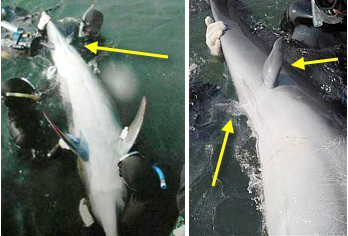
But there's lots more evidence of hind legs in whales and dolphins.  The Talk Origins website gives a good summary here (http://www.talkorigins.org/faqs/comdesc/section2.html#atavisms_ex1).  One example at that site is of external hind legs in a humpback whale, which contained multiple leg bones well over a foot (12 inches/30cm) in length (and the Talk Origins article claims these bones had shrunk and were originally over four feet long).

This photo from the Talk Origins site shows a dolphin, caught in Japan, that has hind flippers:

[Figure2.2.2 (atavistic dolphin flippers)]

You can find other, slightly less objective, sites with similar information, such as:
http://etb-whales.blogspot.co.nz/2012/03/whale-evolution-and-atavistic-hind.html 
http://trueorigins.us/whale-evolution/4583512376
http://trueorigins.us/whale-evolution-continued/4583512432

All of the links I've provided (including Talk Origins) argue strongly against young-Earth creationism, so Sarfati and other young-Earth creationists will dismiss them outright as biased, etc.  However, I'd recommend looking at the sites and their references and then comparing that with the evidence presented by Sarfati, Wieland and other young-Earth creationists.  It's pretty clear to me both sides of the argument are pushing a strong agenda, but one side is a lot more open with the evidence.


Sunday, 16 March 2014

Chapter 14: Kakapos (and how recent is recent?)

On pages 344-5 of The Greatest Show on Earth, Dawkins makes a passing reference to New Zealand's flightless birds.
Moas lost their wings entirely. Their home country of New Zealand, by the way, has more than its fair share of flightless birds, probably because the absence of mammals left wide open niches to be filled by any creature that could get there by flying. But those flying pioneers, having arrived on wings, later lost them as they filled the vacant mammal roles on the ground. This probably doesn't apply to the moas themselves, whose ancestors, as it happened, were already flightless before the great southern continent of Gondwana broke up into fragments, New Zealand among them, each bearing its own cargo of Gondwanan animals.
It surely does apply to kakapos, New Zealand's flightless parrots, whose flying ancestors apparently lived so recently that kakapos still try to fly although they lack the equipment to succeed. In the words of the immortal Douglas Adams, in Last Chance to See, "It is an extremely fat bird. A good-sized adult will weigh about six or seven pounds, and its wings are just about good for wiggling about a bit if it thinks it's about to trip over something - but flying is completely out of the question. Sadly, however, it seems that not only has the kakapo forgotten how to fly, but it has also forgotten that it has forgotten how to fly. Apparently a seriously worried kakapo will sometimes run up a tree and jump out of it, whereupon it flies like a brick and lands in a graceless heap on the ground." [footnote 1]
It's worth noting that Dawkins' comment about the moa's ancestor is now considered out-of-date (though not unanimously), as molecular analysis in 2010 concluded moa evolved from birds that flew to New Zealand.[2]

Dawkins appears to have mentioned the kakapo simply so he could quote the amusing description of the bird made by his late friend Douglas Adams.  Adams' description favours a good story over factual accuracy – kakapo don't run up trees and then jump from them in an attempt to fly, but they do use their wings to help them leap or parachute short distances when descending from trees.[3]  

Unfortunately, rather than pointing this out, Dawkins makes the throw-away comment that the kakapo's "flying ancestors apparently lived so recently that kakapos still try to fly".  If read without an evolutionary time-scale in mind, this comment gives the impression that the kakapo lost the ability to fly only a few generations ago.

Unsurprisingly, Sarfati seizes on Dawkins' flippant comment, particularly his loose use of the word 'recently'.  Sarfati argues the kakapo's flightlessness "is a problem for long-age ideas", because New Zealand was "supposedly" isolated for millions of years but "this flightlessness is clearly recent" (page 256).

The best response to Sarfati (and to Dawkins' poor choice of words) is to clarify what 'recent' might mean in this context.

Broadcaster and natural history writer Alison Ballance outlines the biology, natural history and evolutionary history of the kakapo in her book, Kakapo: Rescued from the Brink of Extinction.  She notes that traditionally parrots have been viewed as "relative latecomers in the bird world, appearing between 12 and 25 million years ago, and reaching here by flying across the Tasman Sea".  In this case, 12 million years ago is considered to be relatively recent.  Where the kakapo fits in the traditional theory is unclear as the fossil record for kakapo is poor.  Ballance suggests the kakapo's flightlessness could even have happened in "the blink of an evolutionary eye", but it's important to note that she characterises this 'blink' as a span of a million years.[4]

For further context: a 2009 paper argued that the moa radiated into new species "just" 5-8.5 million years ago – "much more recently" than previous estimates of 15 million years ago.[5]  Here, 5 million years ago is considered recent on an evolutionary time-scale.

Therefore, while the evolution of the kakapo's flightlessness may be recent in evolutionary time, 'recent' means at least hundreds of thousands of years and, more likely, millions of years.[6]  This is far beyond the maximum 4,500 years allowed by the young-Earth creationist model.[7] 


References: 

[1] Richard Dawkins, The Greatest Show on Earth: the Evidence for Evolution, London: Bantam Press (2009), pp 344-5. 

[2] See my previous post: http://greatesthoaxonearth.blogspot.com/2013/11/geographical-distribution-lost.html and also: David Winter, 'Did the Moa's ancestor fly to New Zealand?' (4 February 2010) http://sciblogs.co.nz/the-atavism/2010/02/04/did-the-moas-ancestor-fly-to-new-zealand/

[3] "This behaviour is most often seen when birds are descending from trees to avoid recapture by conservation managers".  R G Powlesland, D V Merton and J F Cockrem, 'A parrot apart: the natural history of the kakapo (Strigops habroptilus), and the context of its conservation mangement', Notornis, Vol 53, No 1 (2006), p 4; online at http://notornis.osnz.org.nz/system/files/Notornis_53_1_3.pdf 

[4] Alison Ballance, Kakapo: rescued from the brink of extinction, Nelson: Craig Potton Publishing (2010), p 54. 

[5] M Bunce, T Worthy, et al, 'The evolutionary history of the extinct ratite moa and New Zealand Neogene paleogeography', Proceedings of the National Academy of Sciences, Vol 106, Issue 49 (24 September 2009), pp 20646-20651; online at: http://www.pnas.org/content/early/2009/11/17/0906660106.full.pdf 

[6] The Department of Conservation's Kakapo Recovery website says that kakapo may have flown "many hundreds of thousands of years ago": 'How Kakapo Get Around' (2008) http://www.kakaporecovery.org.nz/index.php?option=com_content&view=article&id=84&Itemid=182 

[7] See, for example: Adrian Bates, 'Parrot of the night - NZ's kakapo', Creation, Vol 30, No 4 (2008), pp 28-30; online at: http://creation.com/kakapo

Saturday, 8 March 2014

Chapter 13: 'Simplest Possible Life?'

The following elaborates on a post made by the Amazon user 'stickler', which you can see here.

Chapter 13 of The Greatest Hoax on Earth addresses the origins of life on Earth.  On pages 224-8 Sarfati discusses the complexity of cells and contends that cells have always been too complex to have evolved from any non-cellular structure.  At the end of page 227 he quotes from a New Scientist article (which discusses research into the origins of life) to support his argument:
There is no doubt that the common ancestor possessed DNA, RNA and proteins, a universal genetic code, ribosomes (the protein-building factories), ATP and a proton-powered enzyme for making ATP. The detailed mechanisms for reading off DNA and converting genes into proteins were also in place. In short, then, the last common ancestor of all life looks pretty much like a modern cell.[footnote 1]
Anyone reading the quote in isolation would conclude it supports Sarfati's argument.  But what they would not realise is that Sarfati has quoted the New Scientist article rather selectively.  The article's next sentence, omitted by Sarfati, changes the meaning:
Yet the differences are startling. In particular, the detailed mechanics of DNA replication would have been quite different. It looks as if DNA replication evolved independently in bacteria and archaea, according to Eugene Koonin at the National Center for Biotechnology Information in Bethesda, Maryland.
The article goes on to point out:
"At face value, the defining boundaries of cells evolved independently in bacteria and archaea"...If Martin is right, the last common ancestor of life on Earth was a sophisticated entity in terms of its genes and proteins, and was powered by proton currents rather than fermentation. Yet at the same time, its bounding membranes were apparently different to anything found today. It was life, but not as we know it.
The article then describes 'white smokers' – alkaline hydrothermal vents, an important area of origins of life research (mentioned only in passing by Dawkins in The Greatest Show on Earth, and not addressed by Sarfati).[2]  After outlining how these vents make an ideal setting for the "RNA world hypothesis (which is discussed by Sarfati on pages 234-46), the article concludes:
The last common ancestor of all life was not a free-living cell at all, but a porous rock riddled with bubbly iron-sulphur membranes that catalysed primordial biochemical reactions. Powered by hydrogen and proton gradients, this natural flow reactor filled up with organic chemicals, giving rise to proto-life that eventually broke out as the first living cells - not once but twice, giving rise to the bacteria and the archaea.
The way Sarfati has quoted the New Scientist article gives the impression the last common ancestor was basically as complex as a modern cell, whereas the article actually states the last common ancestor was not even a free-living cell.  Given Sarfati's creative use of non-creationist sources elsewhere in The Greatest Hoax on Earth (see for example pages 57, 106, and 156-7), it is likely he has deliberately used the New Scientist quote out of context.

Part of the problem is that Sarfati seems to have conflated the ideas of a 'simple cell' and of 'simple life'.  But the simplest possible life does not necessarily have to be a cell.  Another complicating factor is that the last common ancestor does not necessarily have to be the simplest possible life, as it may not have been the first living thing.  This is best explained by physicist Paul Davies (whom Sarfati quotes in support of a different point on page 226):
It is important to realise that the last common ancestor of life on Earth is not necessarily the same as the first living thing.  To understand this, it is helpful to use Darwin's metaphor of the tree of life, in which, from a simple originating "trunk," new species have arisen by branching and re-branching over time.  Extant life is represented by the twiglets at the top of the tree.  By tracing back from two extant organisms, their last common ancestor will be encountered at the point where the branches meet.  Taking all life on Earth today, we can imagine following the myriad branches right back to a deep common branching point – the universal ancestor organism.  But this branching point may not lie on the central trunk of the tree.  There may have existed earlier branches of the tree of life that became dead ends, i.e. have no surviving descendants today.
Indeed, from the foregoing it will be clear that the universal ancestor must have already been an immensely complicated and sophisticated organism.  There was surely a long period of prior evolution leading up to it.  Pushing the tree analogy to the extreme, we can identify the origin of life with the single stem (or trunk, or root) from which all the subsequent branches sprang.  Taking this literally implies that all life would have descended from a single microbial Adam.  However, this interpretation is over-simplistic.  Microbiologists know that genes can be transferred laterally between organisms, and this can blur the unique association of species with tree branches.  In the ancient, primitive microbial realm, about which almost nothing is known, the tidy compartmentalisation into different competing species may have broken down.  All we can really say with confidence is that all life on Earth has descended from a community of genetically promiscuous closely inter-related microbes.


References: 

[1] Nick Lane, 'Was our oldest ancestor a proton-powered rock?', New Scientist, Issue 2730 (19 October 2009) http://www.newscientist.com/article/mg20427306.200-was-our-oldest-ancestor-a-protonpowered-rock.html; available in full online at: http://www.sott.net/articles/show/195226-Was-our-oldest-ancestor-a-proton-powered-rock

[2] A summary of the hydrothermal vent theory accompanied the New Scientist article cited above.  It is available in full online.  See: Nick Lane and Michael Le Page, 'How life evolved: 10 steps to the first cells', New Scientist, Issue 2730 (2009) http://www.newscientist.com/article/dn17987-how-life-evolved-10-steps-to-the-first-cells.html

[3] Paul Davies, 'The origin of life I: When and where did it begin?', Science Progress, Vol 8, No 1 (2001) http://cosmos.asu.edu/publications/papers/OriginsOfLife_I.pdf

Sunday, 2 March 2014

Chapter 12: Ocean Salinity

On pages 215-18 of The Greatest Hoax on Earth, Sarfati gives a relatively lengthy discussion of the salt in the Earth's oceans as something that proves the Earth must be thousands, not billions, of years old.

Here's a link to a paper titled 'Ocean Salinity as a Failed Scientific Clock'.  The paper is written by a graduate student and explains simply and clearly why young-Earth creationist are being disingenuous when they use ocean salinity to claim the Earth can't be billions of years old.  

Here's an excerpt from the paper that serves as a good summary:

For a process to be considered a good natural clock, it must contain the following: a known initial condition, an irreversible process, a uniform rate, and a final condition. With the salt clock, the initial condition is not known. The process of salt accumulation has been proven to be reversible and in constant change. There is also no uniform rate of accumulation of salt. The only criterion met is the known final condition. Because of these factors, the salt clock can obviously not be used as a natural clock to calculate any type of age.
Despite the known scientific reasons for which this method cannot be used as an accurate natural clock, measuring the salinity of the ocean has recently been used by young earth creationists as supposed proof that the earth is not, in fact, billions of years old. The website Answers in Genesis, a young earth proponent, actually explains the salt clock as a valid measuring device. According to the site, "Many processes bring salts into the sea, while they don't leave the sea easily. So the saltiness is increasing steadily. Since we can work out how much salt there is in the sea, as well as the rates that salts go into and out of the sea, we should be able to calculate a maximum age for the sea (Sarfati)."
What is even more curious about this selected article is that the author even cites the works of John Joly and Edmund Haley in his references. The works of Joly and Haley, while vital in tracing the progression of scientific thought on the age of the earth, are in no way current or up to date. The article fails to comment on the shortcomings of the salt clock, and concludes by reiterating that the amount of salt present in today's oceans coincides with the age of the earth according to biblical accounts.

Monday, 20 January 2014

One-Sided Information (mostly chapter 12)

One error made in The Greatest Hoax on Earth is what Christian astronomer Matthew Tiscareno has termed the 'one-sided equation fallacy':
A large class of "evidences" presented by young-Earth advocates involve measuring rates of various Earth processes, then attempting to extrapolate them backwards for millions of years.  Generally, the purpose is to show that the process in question would build up to absurdity if it were allowed to continue through "evolutionary timescales."  The fallacy of most claims of this type is a failure to recognize the importance of equilibrium.  Most processes on Earth are in a state of balance, in which one process (such as erosion of the continents) is counteracted by others (such as emplacement of new continental material by volcanoes and tectonic uplift).  Generally, processes on Earth do not build up without limit, because there is always another process that opposes the build-up, leading to the establishment of equilibrium.
The method for dealing with young-Earth claims of this type is to look for the limiting process that imposes equilibrium.  In some cases the balancing process has simply been overlooked, and the young-Earth claim is laid to rest by pointing it out.  Other times the balancing process is not well understood or even unknown, which may seem to lend credence to young-Earth claims.  However...[u]nless we can prove that no balancing process exists (and in most cases that cannot be done), we should adopt the working hypothesis that there is a yet-to-be-discovered process that provides the equilibrium.  Examples of the One-Sided Equation Fallacy include the influx of magma on the Earth's crust, the erosion of sediment from continents, the maximum life of comets, and helium-4 in the atmosphere.[footnote 1]
This same error is described by Christian physicist Roger Wiens in his helpful essay, 'Radiometric Dating: A Christian Perspective':
There are a number of parameters which, if extrapolated from the present without taking into account the changes in the Earth over time, would seem to suggest a somewhat younger Earth.  These arguments can sound good on a very simple level, but do not hold water when all the factors are considered.  Some examples of these categories are the decaying magnetic field (not mentioning the widespread evidence for magnetic reversals), the saltiness of the oceans (not counting sedimentation!), the sedimentation rate of the oceans (not counting Earthquakes and crustal movement, that is, plate tectonics), the relative paucity of meteorites on the Earth's surface (not counting weathering or plate tectonics), the thickness of dust on the moon (without taking into account brecciation over time), the Earth-Moon separation rate (not counting changes in tides and internal forces), etc.  While these arguments do not stand up when the complete picture is considered, the case for a very old creation of the Earth fits well in all areas considered.[2]
Sarfati uses a one-sided approach in several places in his book, such as his arguments about:
  • genetic entropy in chapter 4 (which fails to mention the balancing processes of synergistic epistasis and soft selection) 
  • ocean salinity in chapter 12 (which fails to mention the various processes by which oceans lose salinity)
  • comets in chapter 12 (Sarfati acknowledges the Kuiper Belt and the Oort Cloud, but he is selective in the information he provides on them[3])
  • Earth's magnetic field in chapter 12 (which mentions but fails to properly engage the evidence for multiple reversals of the Earth's magnetic field over long periods of time in the Earth's past - see here [though your eyes may not be able to handle the appalling design of that webpage]).


References: 

[1] Matthew Tiscareno, ‘Is There Really Scientific Evidence for a Young Earth?’ (2000) http://chem.tufts.edu/science/Geology/OEC-refutes-YEC.htm 

[2] Roger Wiens, ‘Radiometric Dating: A Christian Perspective’ (2002) http://www.asa3.org/ASA/resources/Wiens.html 

[3] See here for an explanation: Ian Musgrave, ‘Where do comets come from?’ (2009) http://pandasthumb.org/archives/2009/05/where-do-comets.html